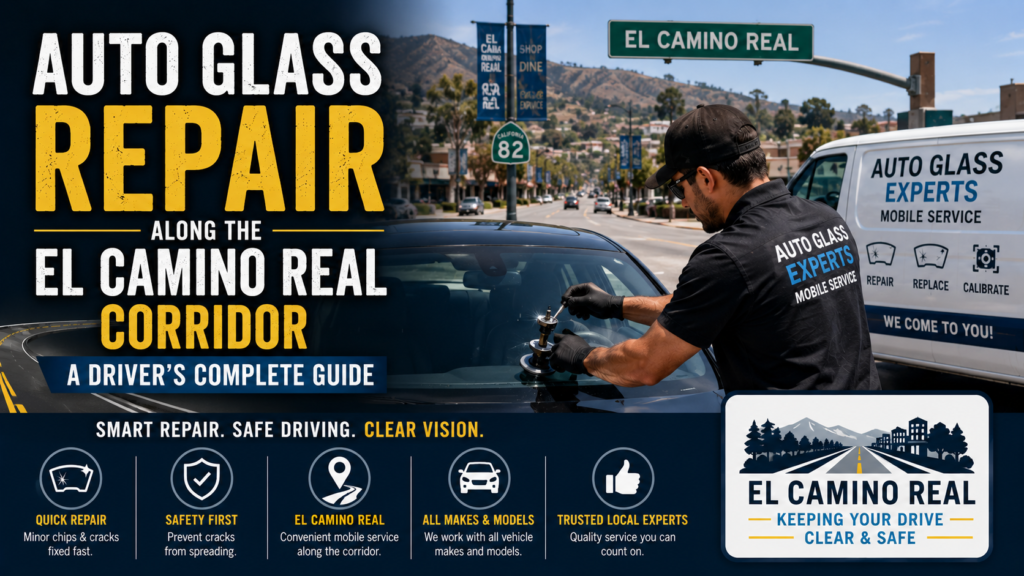
The El Camino Real Corridor is one of the most heavily traveled roadways in the Bay Area, stretching through multiple cities across Santa Clara County and serving as a daily artery for commuters, shoppers, and residents of the peninsula. This constant flow of traffic from passenger vehicles and delivery trucks to commercial buses means the road surface sees significant wear, and the debris it generates puts vehicle windshields and auto glass at constant risk.
From small rock chips flicked up by passing trucks to side window damage from parking lot incidents, auto glass damage along the El Camino Real Corridor is a routine reality for many drivers. Understanding what Auto Glass Repair El Camino Real Corridor involves, when it is appropriate versus replacement, and how the process works from start to finish helps drivers in this corridor make informed, safety-conscious decisions when damage occurs.
The Role of Auto Glass in Vehicle Safety
Auto glass is frequently taken for granted it is simply the transparent barrier between the occupants of a vehicle and the outside world. But the glass on a modern vehicle, particularly the windshield, serves a far more critical safety function than most drivers appreciate.
The windshield contributes directly to the structural integrity of the vehicle’s cabin. In a frontal collision, it prevents occupants from being ejected. In a rollover, a properly bonded windshield provides crucial resistance to roof crush, protecting the occupants within. The windshield also provides the backstop for front passenger airbag deployment if the glass is not properly bonded, the airbag may not deploy in the correct direction, significantly reducing its protective effectiveness.
Side windows and rear glass, while made from tempered glass with different breakage characteristics, contribute to occupant containment in side-impact collisions and help maintain the structural shell of the vehicle. Understanding these safety functions underscores why auto glass repair and replacement must be performed correctly, using appropriate materials and techniques, by qualified technicians.
How Damage Happens: Common Causes Along a High-Traffic Corridor
The El Camino Real Corridor’s mix of commercial traffic, frequent stop-and-go conditions, construction zones, and high vehicle density creates multiple opportunities for auto glass damage.
Road Debris Strikes: Commercial trucks, landscaping vehicles, and construction equipment frequently shed small stones, gravel, and other debris onto the road surface. When vehicles traveling at speed pass over or near this debris, it can be propelled upward and forward with surprising force, striking the windshield of a following vehicle. This is the most common cause of windshield chips along any high-traffic corridor.
Temperature Fluctuations: Even after a chip occurs, the process of crack propagation often depends on temperature changes. In the Bay Area, the swing between cool morning fog and afternoon warmth causes glass to expand and contract. An untreated chip can spread into a long crack seemingly overnight due to this thermal stress, turning a repairable piece of damage into a situation requiring full replacement.
Parking Incidents: Parking lots and street parking along the El Camino Real Corridor create situations where side windows and rear glass are vulnerable to damage from shopping carts, adjacent vehicles, and other objects. This type of damage typically involves tempered glass and usually requires replacement rather than repair.
Vandalism: Urban corridors also see occasional vandalism-related glass damage, which typically results in complete breakage and immediate need for replacement to secure the vehicle.
Repair vs. Replacement: How Professionals Decide
One of the most important decisions in auto glass service is determining whether a damaged windshield can be repaired or must be replaced. This decision is based on a structured assessment of several factors.
Size of the Damage: As a general guideline used across the auto glass industry, chips smaller than approximately one inch in diameter and cracks shorter than six inches are candidates for repair. Damage larger than these thresholds has typically compromised enough of the glass structure that repair cannot reliably restore integrity.
Location of the Damage: The position of the damage on the windshield is critically important. Damage within the driver’s primary line of sight the area swept by the main wiper blade directly in front of the driver typically requires replacement, because even a successfully completed repair may leave optical distortion that impairs visibility. Similarly, damage within two inches of the windshield’s edge, known as edge damage, tends to spread rapidly and indicates structural compromise that repair cannot address.
Depth and Layers Affected: The windshield consists of an outer glass layer, the PVB interlayer, and an inner glass layer. Most repairable damage affects only the outer layer. When the interlayer is compromised indicated by a white or milky appearance in the damaged area replacement is generally necessary.
Number of Damage Points: Insurance guidelines and industry standards typically allow for the repair of up to three chips in a single windshield. Multiple repairs in close proximity or damage to an area that has been previously repaired is not a candidate for further repair.
The Science of Windshield Chip Repair
Windshield chip repair is a precise technical process that, when performed correctly by a trained technician using high-quality materials, can restore the structural integrity of the glass and significantly improve its appearance.
The process begins with preparation: the damaged area must be clean and dry. Any moisture within the chip or crack will prevent the repair resin from bonding properly and can lead to optical cloudiness or repair failure. Technicians use vacuum processes and, if necessary, carefully applied heat to ensure the damage area is free of contaminants.
A specialized injector is positioned over the damage and used to create a vacuum, drawing out any remaining air from within the chip. The repair resin a clear polymer with optical and physical properties closely matching those of glass is then injected under controlled pressure to fill the void completely.
Once the resin has filled the damage, UV light is applied to cure and harden it. The technician then removes any excess resin from the surface and polishes the area. The result is a windshield in which the damaged area has been structurally reinforced and visually improved, though in most cases some evidence of the original damage will remain visible under certain light conditions.
The primary objective of chip repair, as stated by the Auto Glass Safety Council, is to restore the structural integrity of the windshield and prevent the damage from spreading further with visual improvement as a secondary benefit.
Windshield Replacement: The Step-by-Step Process
When the extent of the damage makes repair inappropriate, windshield replacement is the necessary path forward. The replacement process, while more involved than repair, is a well-established procedure that a qualified technician can complete in approximately one to two hours.
After protecting the vehicle’s interior and exterior from potential damage, the technician carefully removes the existing windshield by cutting through the urethane adhesive bond using specialized tools. The windshield opening called the pinch weld is then cleaned and inspected. Any rust, old adhesive residue, or damage to the pinch weld must be addressed before the new glass is installed, as any contamination or irregularity in this area can compromise the new windshield’s bond and waterproofing.
A primer is applied to the pinch weld to prepare the surface for adhesion, followed by a fresh bead of high-quality automotive urethane. The new windshield is carefully positioned using suction cups and set into the adhesive. Alignment is confirmed, and any excess adhesive is cleaned away.
The vehicle must then remain stationary during the safe drive-away time to allow the urethane to achieve the minimum bond strength required for road use. Reputable technicians will provide clear guidance on this waiting period based on the specific adhesive used and ambient conditions.
ADAS and Windshield Technology in Modern Vehicles
Vehicles traveling the El Camino Real Corridor increasingly include sophisticated ADAS technology a reflection of the broader industry trend toward automated safety systems. Lane keeping assist, forward collision warning, automatic emergency braking, and adaptive cruise control are all systems that commonly rely on cameras mounted at or near the windshield.
When such a windshield is replaced, the camera position changes by even a fraction of a degree compared to the original factory calibration. Without recalibration, the system may function incorrectly providing false alerts, failing to detect hazards, or operating the vehicle’s automatic responses inappropriately.
Recalibration is not optional for ADAS-equipped vehicles; it is a required step in the windshield replacement process. Drivers should confirm before scheduling replacement service that their provider has the appropriate diagnostic tools and training to perform the calibration required by their specific vehicle make and model.
In addition to ADAS cameras, many modern windshields incorporate other technologies including rain sensors, heating elements, acoustic interlayers, and heads-up display (HUD) projection zones. Replacement glass must be compatible with these systems, and technicians must handle and install the glass with awareness of these features.
Maintaining Your Auto Glass: Prevention and Care
While auto glass damage is often sudden and unavoidable, there are practices that can reduce both the frequency and severity of damage and extend the life of windshields and other vehicle glass.
Maintaining a safe following distance particularly behind trucks, construction vehicles, and debris-laden flatbeds reduces exposure to projectile debris. On high-traffic corridors like El Camino Real, where the presence of commercial vehicles is constant, this is one of the most practical risk-reduction measures available.
Addressing chips promptly before they spread into cracks is the single most effective action a driver can take to reduce auto glass costs over time. A chip that costs relatively little to repair can, within days, become a crack requiring full windshield replacement.
Quality wiper blades and proper windshield washer fluid also contribute to glass longevity. Worn wiper blades can create fine scratches across the windshield surface over time, reducing optical clarity and potentially weakening the glass. Parking in shaded areas when possible reduces the thermal stress that causes small chips to propagate.
For residents and commuters along the El Camino Real Corridor, where vehicle use is frequent and road conditions contribute to ongoing glass stress, treating auto glass as the safety component it truly is rather than simply a functional convenience is the right mindset for long-term vehicle safety.